Book review
The Irish Keen
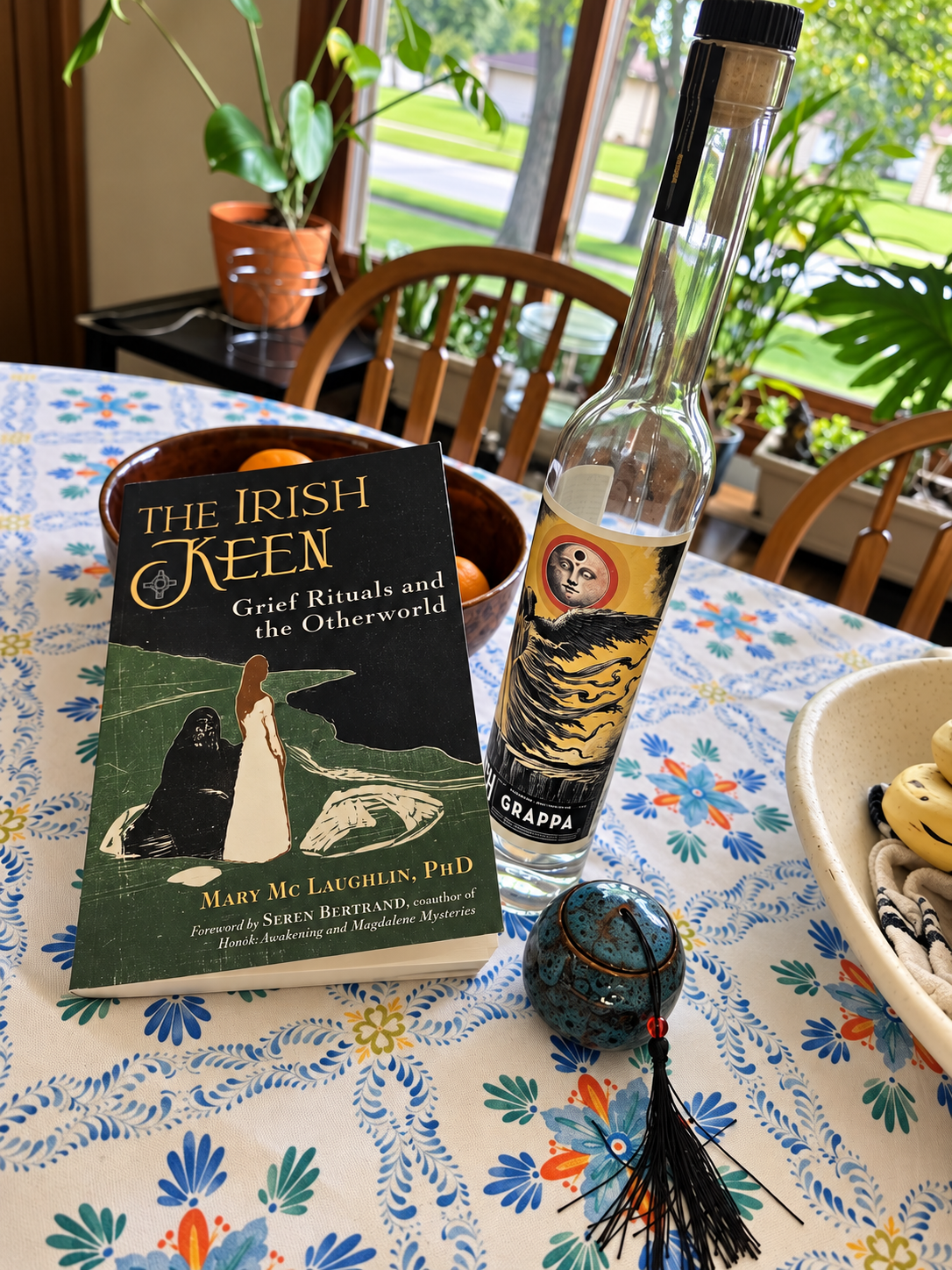
Review
A book about how the Irish historically handled the loss of someone they loved? Count me in.
Over the last few years, I have lost an entire branch of my family tree. They all claimed Irish blood. (Though, let’s be real, even calling us Irish American is a stretch.) Still, my family has always had a few unusual traditions surrounding death and grieving, and The Irish Keen by Mary Mc Laughlin shed some unexpected light on why we may have done some of the things we did.
Mc Laughlin begins by carefully untangling the language surrounding Irish mourning traditions. Words that are often used interchangeably actually describe very different parts of the grieving process. Take notes as you read, because you will almost certainly find yourself referring back to those definitions later.
Throughout the book, Mc Laughlin beautifully blends historical sources, folklore, academic research, and her own personal experiences with death and mourning. The result is a book that feels scholarly without becoming detached from the very human subject at its center.
One particularly interesting discussion concerns children’s changing role in death and mourning. Mc Laughlin describes how she and other children of her generation were often excluded from wakes, funerals, and other parts of the grieving process, even though only a generation or two earlier, children would have been fully involved. I could relate to this immediately. I, like many other American children, was also largely excluded from these experiences until my teenage years.
Just as compelling are the moments when Mc Laughlin reflects on her own mother’s funeral and the ways she instinctively responded to grief before she had even begun researching the traditions explored in this book. Those personal reflections help demonstrate how cultural practices can survive quietly within families, even after people have forgotten where they came from.
I was especially fascinated by how many roles connected with wakes and funerals could once be outsourced to professionals.
Women might be hired to lead mourners in cries of grief. Other individuals—sometimes people who may have barely known the deceased—could be paid to attend and proclaim how charitable, loving, honorable, or pious that person had been. Someone might even be brought in to organize games, entertainment, or activities that could be surprisingly raunchy, at least by the standards of the time.
That brings me to one idea from this book that stayed with me most: grieving does not have to be exclusively about sadness.
It can also be about celebrating the deceased and the mourners’ own lives.
And the Irish certainly knew how to celebrate.
There was not one rigid, prescriptive formula for every wake or funeral. A gathering might begin solemnly, filled with crying and expressions of grief, and later become something closer to a celebration of life—particularly after those most deeply affected had retired for the evening.
Alcohol and cigarettes might be offered to visitors. I had never heard about the significance of cigarettes in the wake tradition before reading this book, but Mc Laughlin explains both the practice and the reasoning behind it. Games might be played. Stories would be told. Songs might be sung. People might joke, tease one another, flirt, drink, and laugh.
At first glance, that mixture may seem strange. Yet Mc Laughlin repeatedly returns to the idea of liminality.
A wake exists between worlds.
We are standing between life and death. Between grief and celebration. Between the person who was here yesterday and the memory that will remain tomorrow.
In that space, emotions do not behave neatly. People cry and then laugh. They mourn and then tell a ridiculous story about the deceased. They confront death while simultaneously reaffirming life.
It is a whirlwind of emotions, capable of changing from one moment to the next. And perhaps that is exactly the point.
Mc Laughlin also brings Irish mythology and folklore into the discussion, showing how older beliefs surrounding death and the Otherworld influenced mourning traditions.
One revelation genuinely surprised me. Even though Brighid is my patron goddess, I had no idea she was traditionally associated with being the first keener. Mc Laughlin also explores the role of the Bean Sidhe—the banshee—and how elements of her mythology became intertwined with keening and with the women who performed it.
The book also considers beliefs surrounding what happened to the soul after death and how those ideas shaped the treatment of the body, the wake, the funeral, and the behavior of those who gathered around the deceased. These mythological sections help show that the Irish wake was never simply a social gathering. It existed within a much larger understanding of death, community, memory, and the boundary between this world and the next.
Another welcome addition is the discography included for readers who would like to hear examples of keening for themselves. After reading so extensively about the practice, being able to seek out recordings adds another dimension to understanding it.
Overall, I give The Irish Keen 5 out of 5.
It is thoroughly researched, rich with historical and mythological references, and remarkably accessible considering the depth of the subject matter. Mc Laughlin does an excellent job explaining not only what people did when someone died, but why those practices mattered.
Perhaps most surprisingly, this is also a book filled with what I can only describe as feel-good stories.
That sounds strange to say about a book centered on death and grief, but that may be one of its greatest strengths. The Irish Keen reminds us that mourning is not simply about losing someone. It is also about gathering together, remembering them, telling their stories, laughing at the things they did, crying because they are gone, and somehow carrying them forward with us.
In other words, it is as much a book about living as it is about dying.
A Note on Terminology
I have always disliked hearing the word ‘shamanism’ associated with continental European practices. It feels out of place and disrespectful in a cultural-appropriation kind of way. However, I feel a little more accepting of it given how Mc Laughlin approaches the subject, explaining it as a role with one foot on the side of the living and the other on the side of the dead—at least in this context.
A Personal Anecdote
And a personal anecdote, because anyone who truly knows me knows that I have a lot of feelings about death.
I refuse to visit a graveyard—my grandpa always found it funny that I insisted on calling it a graveyard instead of a cemetery—unless I am there for a burial. For whatever reason, I have never found much comfort in graves themselves. Instead, I create my own memorials.
For family members I have lost, I keep urns dedicated to them. Inside are small things that help preserve something of who they were and who they were to me: an obituary, a birthstone, a fingerprint, a strip from a heartbeat monitor, and other personal items that connect me to that person.
I have even brought those urns with me to the hospital or funeral, almost as if I were trying to capture some small part of the moment before it disappeared. Perhaps, subconsciously, that is exactly what I am doing—creating a physical focal point that can return me to a particular person, time, and place long after the immediacy of grief has passed.
My own grieving process tends to be relatively short. The most intense part rarely lasts more than a day or two after the funeral. That does not mean I forget the person or stop missing them. I simply do not experience death as a complete ending. I continue to ‘talk’ to the people I have lost, sometimes seriously and sometimes with the same humor I would have used with them while they were alive.
That humor extends to my own death as well.
I have joked, ‘Cremate me, put my ashes into a bottle of vodka, and have everyone take a shot of me. One last party.’
Or, ‘When I die, put my body in a dumpster so I can scare somebody one last time.’
Morbid? Probably.
But I have started to wonder whether that humor serves the same purpose as some of the traditions described in The Irish Keen. Death does not have to be approached only with fear, silence, and solemnity. Sometimes laughter creates just enough distance for us to look directly at something that otherwise terrifies us.
Perhaps joking about my own death is simply my way of stripping it of some of its power. If I can laugh at it, plan for it, and imagine one final ridiculous story being told at my expense, then maybe death becomes a little less frightening—and a little more human.
This page contains an affiliate link. If you make a qualifying purchase through it, I may earn a small commission at no additional cost to you.
Conversation beneath the branches
Comments
No approved comments yet. You may be the first to join the conversation.