I had stumbled across an advertisement in Game Informer magazine—an advertisement that also helped me recruit some schoolmates to play with me—for Nexus: The Kingdom of the Winds. Nexus is a massive multiplayer online role-playing game set in an East Asian mythological world. When I began playing it, the Internet itself was still relatively new. I was using dial-up, and the sound of the modem connecting still resonates in my memory as “bing boooong bing.”
Nexus offered much more than killing monsters and leveling up. Its world had clans, social structures, religious systems, philosophical concepts, player-controlled customs and traditions, and specialized subpaths that encouraged players to immerse themselves in its history and culture. Nearly thirty years later, the official Nexus website still describes its world as grounded in Asian mythology, and its community structure still includes subpaths such as Diviner, Geomancer, Shaman, Druid, Monk, and others.
Through the Diviners, playing my character Guia, I discovered something that has remained with me long after most of my teenage interests have faded. The Diviner subpath uses several methods of divination, including actual I-Ching readings. Diviners must understand the fundamental principles of the I-Ching and can purchase sets of three brass coins for readings. The Diviner Guides also have a potent spell that provides in-game benefits.
As a young person, I found this enthralling. I wanted to understand what the combinations of broken and solid lines represented. I wanted to know why a trigram could represent thunder, earth, water, fire, or heaven. Most significantly, I began to realize that the system in the game was leading me toward something outside the game. So I began to research. What I found was considerably larger than I could have imagined: the I-Ching, commonly called the Book of Changes.
Although it began as a divinatory tool, the I-Ching developed into one of the most significant works of Chinese philosophy. It has generated an immense body of commentary and interpretation concerning morality, cosmology, politics, decision-making, and the nature of change itself. At its core are deceptively simple symbols: a solid yang line and a broken yin line.
My in-game instructor scolded me for the way I remembered which was which. At thirteen, I decided that tails are a butt, which has an opening; therefore, tails were yin. Butts were generally considered bad. Bad has three letters, just like yin. Heads were solid. Head has four letters, just like good, just like yang. It was not an elegant system, but it was mine.
Three lines combine to form one of eight trigrams. Two trigrams placed together create a hexagram, giving sixty-four possible combinations. A reading can then show changing lines, created by three heads or three tails, that transform one hexagram into another. The initial hexagram presents an image of a particular circumstance or state of affairs; the changing lines show movement from one state into another.
Ultimately, I found change far more captivating than fortune-telling. In my early years, I naturally approached the I-Ching by asking, “What is likely to occur?” After many years of practice, I have come to understand that this is not usually the most engaging question. Instead, the I-Ching encourages me to ask: What sort of circumstances am I living within? What energies surround me? Where am I resisting a transformation already underway? When should I act? When should I wait?
At thirteen, I did not understand any of those ideas. I simply thought the trigrams were interesting. Sometimes interest is enough. One curiosity sparked another. I studied the trigrams and then the hexagrams. I conducted readings. I read multiple translations and interpretations. What began as an experience on a computer screen became part of my spiritual practice.
I have continued to practice with the I-Ching ever since. That origin story feels fitting, because the I-Ching itself is a book about unexpected transformation. A seemingly insignificant event can set a larger process in motion. One set of circumstances gradually becomes another. We rarely recognize a moment’s significance while we are living through it. At thirteen, I believed I was merely playing a video game. Unbeknownst to me, within that pixelated kingdom I had encountered a spiritual discipline that would accompany me through much of my life. Perhaps the Book of Changes would appreciate the irony.
Notes
Although I said I had no older spiritual mentor teaching me the I-Ching, I do want to thank xKianaX, my Guide in the Diviner subpath, who taught me its basics many decades ago.
Nexus has also brought many important people into my life. Some of my best friends in real life began as fellow players. It remains wild to me that people I met on the internet now live only an hour or so away. Perhaps one day I will write about those relationships.
I still remember getting my first copy of the I-Ching. I bought it at Borders in Regency Mall. My stepfather, who was vehemently Baptist, destroyed it because he considered it “a work of the Devil.” He destroyed my Pokémon games and cards for the same reason, and later did the same to my witchcraft books.
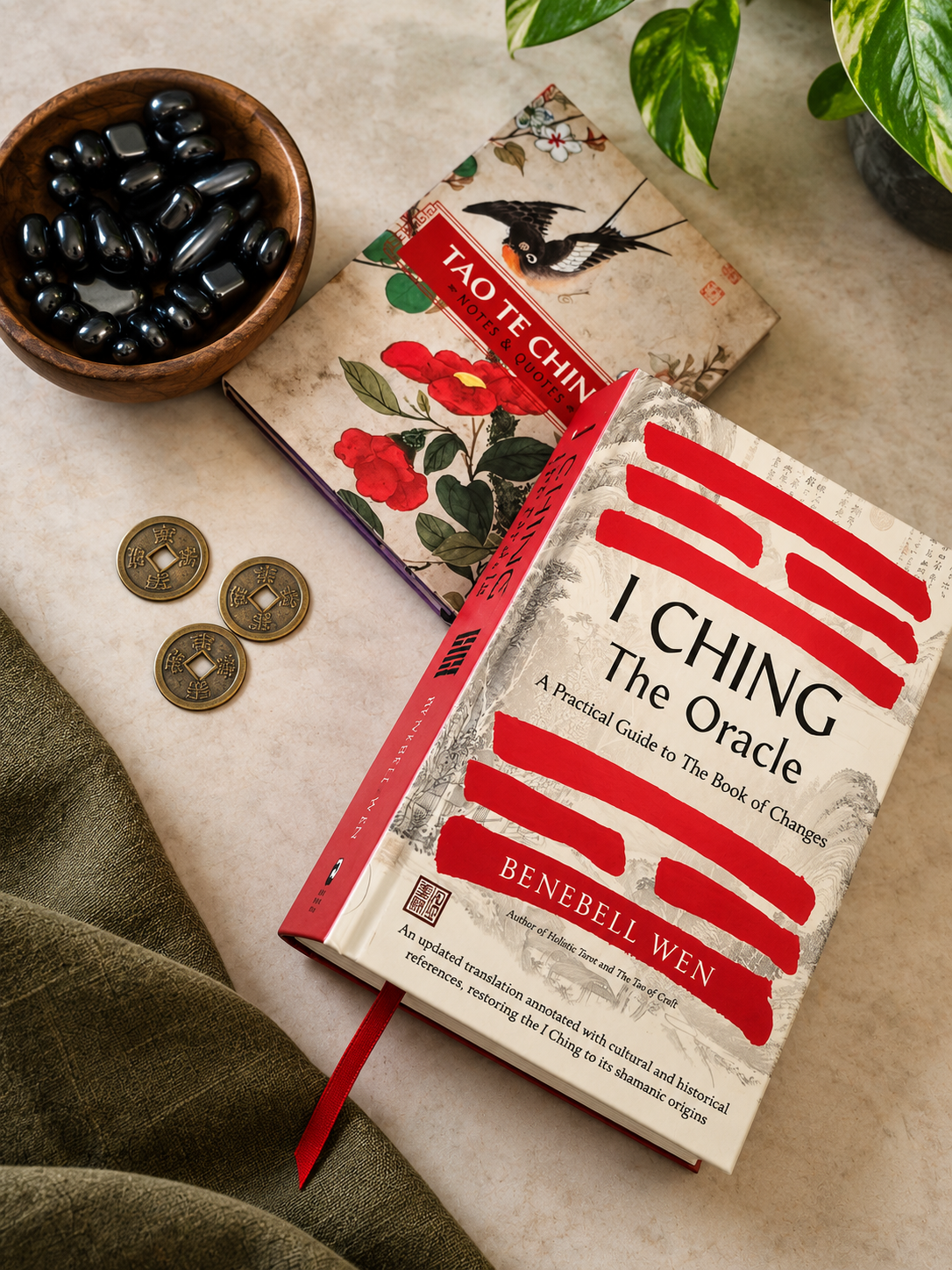
The most recent copy of the I-Ching I use is by Benebell Wen. (I purchased this one because Benebell's “Tao of Craft” was an amazing book I bought while living in NYC.) I will not review it in entirety because it is quite lofty. However, it is very helpful to newly interested folks in understanding many of the concepts involved. You can purchase a copy here.
Conversation beneath the branches
Comments
No approved comments yet. You may be the first to join the conversation.